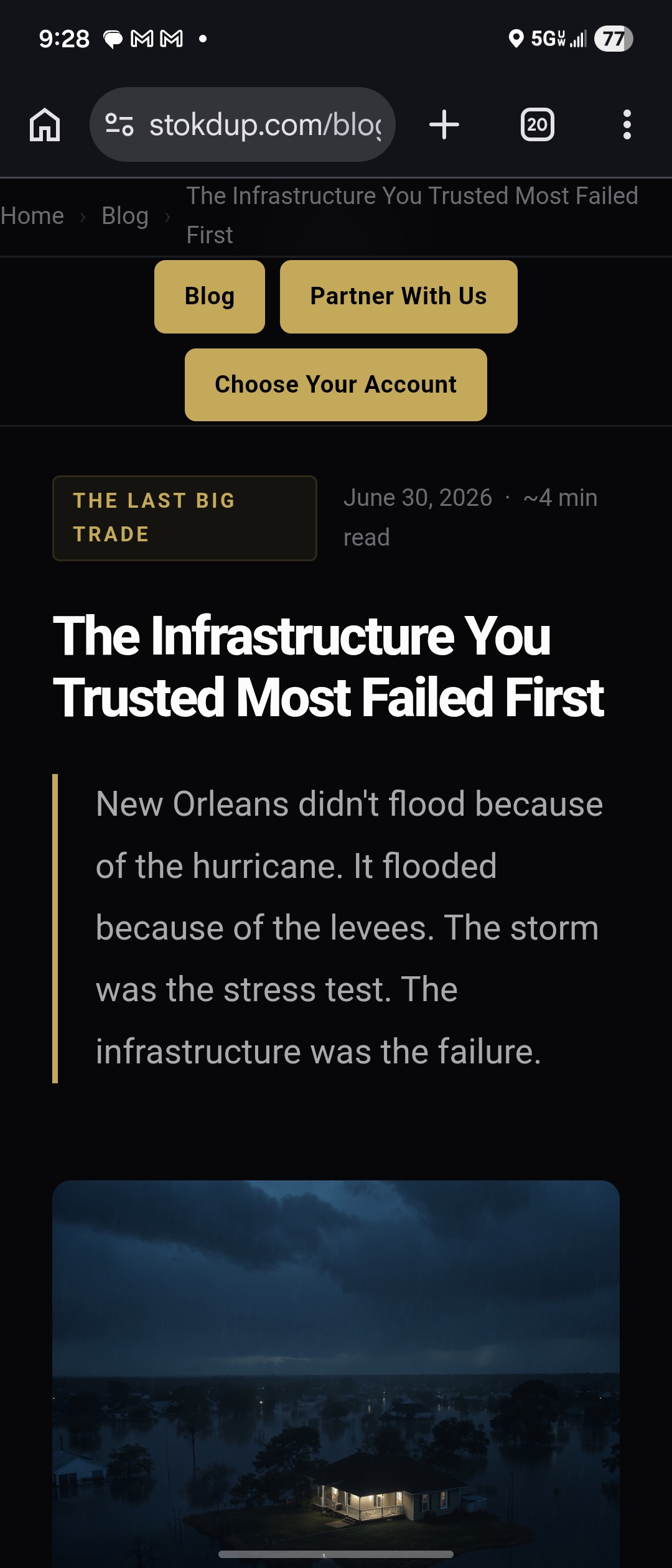
Hurricane Katrina made landfall on August 29, 2005 as a Category 3 storm — weaker than forecast.
The levees were built to withstand a Category 3. They failed anyway.
The Army Corps of Engineers later concluded the levee system had design flaws that predated the storm by decades. Infrastructure that had been rated, certified, and trusted for 40 years catastrophically failed under conditions it was theoretically designed to handle.
Eighty percent of New Orleans flooded. 1,800 people died. Some of them drowned in their attics.
This is not a story about a storm that was too strong. It's a story about infrastructure that was trusted past the point of evidence.
New Orleans residents didn't fail to prepare. They prepared for the system that was supposed to protect them — the levees, the emergency management apparatus, the coordinated federal response. They priced that system at its rated value and built their contingency planning around its guaranteed performance.
Every single layer failed in sequence.
The levees failed. Then the communication infrastructure failed. Then the supply chain failed. Then the coordination between agencies failed. Then the evacuation infrastructure failed for the people who needed it most.
Each failure cascaded into the next because each layer had been assumed rather than verified.
The financial parallel is exact.
When investors concentrate risk in a single asset class, they typically do it because that class has always performed. The failure scenario feels distant. The track record is long. The rated performance is high.
Katrina's levees had a long track record too.
The households that came through the aftermath with the least damage — financial and physical — were the ones who had not concentrated their survival infrastructure in any single layer. Not just the government. Not just the supply chain. Not just the insurance system, which took years to pay out and paid pennies on the dollar for many.
They had built depth. Multiple layers that could each independently fail without cascading into total loss.
The Katrina lesson isn't "don't trust infrastructure." Infrastructure is real and most of it works most of the time.
The lesson is don't price infrastructure at certainty. Build the hedge before you need it. The water doesn't wait for you to finish the trade.
StokdUp exists for households who have stopped treating infrastructure as a guarantee. Membership is by reservation.