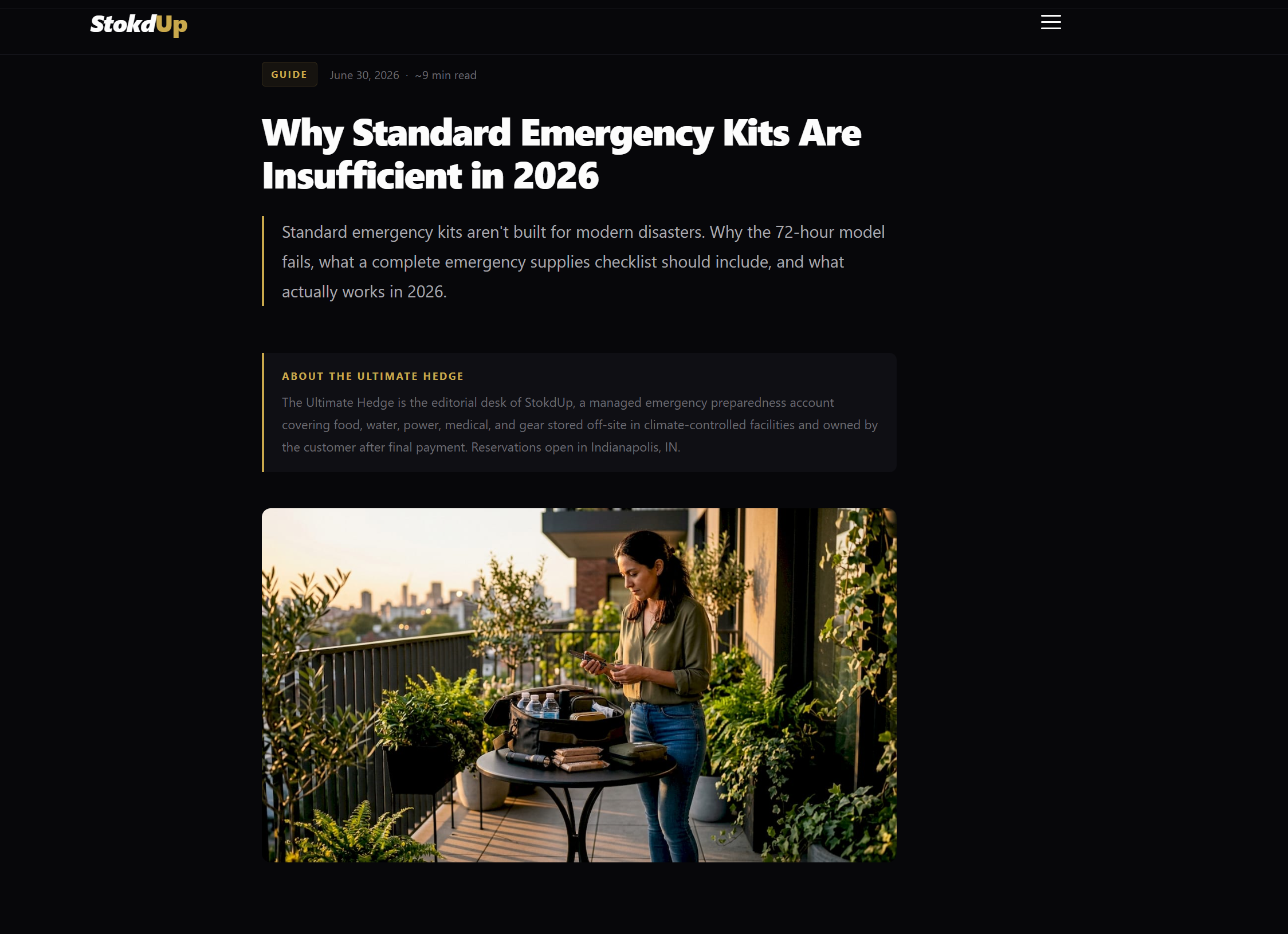
Why Standard Emergency Kits Are Insufficient: The Core Supply Gaps
Walk into any big-box store and you'll find a "72-hour emergency kit" for $49.99. It comes in a bright red bag, contains roughly 1,200 calories per person, a few bandages, and a single emergency whistle. The label says it's designed for emergencies. What it's actually designed for is the shortest, mildest version of one.
The gap between what standard emergency kits provide and what modern disasters actually require has never been wider. Hurricanes don't cooperate with 72-hour timelines. Wildfires produce air quality events that last weeks. Winter grid failures stretch days into a week or longer. The kit in your closet — or the one you've been meaning to buy — wasn't engineered for any of this.
This article breaks down the specific gaps in standard emergency supplies, explains why the 72-hour model is functionally a myth, and describes what a supply system that actually holds up looks like.
(not enough in 2026)
supply disruption
Puerto Rico, Hurricane Maria
Let's start with the four supply categories where standard kits fall shortest — and why those gaps become life-threatening in a real extended emergency.
Water: The Most Under-Supplied Category
Standard emergency kits include roughly 3 liters of water per person — enough for about one day of minimal consumption. The recommended minimum is 1 gallon (3.78 liters) per person per day, covering drinking and basic hygiene. For a family of 4 over a 14-day event, you need 56 gallons. Most kits include 1.5.
Municipal water supplies are among the first casualties of major disasters. After Hurricane Harvey, parts of Houston had boil-water advisories for two weeks. After the Flint crisis, residents went years without reliable tap water. The water problem isn't a short-term problem — it's often one of the longest-lasting infrastructure failures after a disaster.
Power: More Than a Convenience
Power outages kill people — not through dramatic scenarios, but through slow-motion failures. Refrigerated medications spoil. CPAP machines go dark. Medical equipment for elderly household members loses power. Communication devices die. The standard kit's answer to this is usually a few AA batteries.
After Winter Storm Uri in Texas (2021), over 246 people died — primarily from hypothermia, carbon monoxide poisoning from improvised heating, and medication failures related to power loss. A 9-volt battery and a flashlight don't address any of those risks.
Communication: The Infrastructure That Fails First
Cell networks are designed for normal traffic loads, not disaster traffic loads. Within hours of a major event, towers are overloaded, then structurally damaged, then without power themselves. After Hurricane Maria, 95% of Puerto Rico's cell infrastructure was destroyed. After the Camp Fire in Paradise, California, most cell service in the evacuation zone was down for weeks.
Standard kits include a hand-crank radio at best. The assumption is that you'll be able to communicate with family, emergency services, and the outside world using normal infrastructure. That assumption fails regularly.
Single-Location Dependency: The Risk Nobody Talks About
Every home-based emergency supply system shares one critical vulnerability: it's in your home. If you evacuate — mandatory or voluntary — you leave your supplies behind. If your home floods, burns, or becomes inaccessible, your prep becomes inaccessible with it. Approximately 14 million Americans live in 100-year floodplains. Tens of millions more are in wildfire risk zones.
The home-based kit model assumes the emergency happens to your neighborhood but not your house. That assumption fails often enough to be a structural problem with the model.
What a Complete Emergency Supplies Checklist Should Include
A realistic emergency supplies checklist starts with what the threats actually are, then works backward to what you need. Here's the comparison between what standard kits provide and what a complete emergency supply system requires:
| Supply Category | Standard Kit | What's Actually Needed |
|---|---|---|
| Water | 3 liters/person (1 day) | 1 gal/person/day × 14 days minimum; filtration system for renewable access |
| Food | 1,200 cal/person/day, 3 days | 2,000+ cal/person/day, 14–30 day supply; 25-year shelf life storage |
| Power | AA/AAA batteries, flashlight | Portable power station 1,000Wh+; solar charging; medical device continuity |
| Communication | Hand-crank radio (receive only) | Satellite communicator (2-way); backup when cell infrastructure fails |
| Air quality | Not addressed | HEPA air purifier; N95 respirators; protection for wildfire smoke, industrial events |
| Medical | Basic bandages, aspirin | Trauma kit; prescription backup (90-day supply); chronic condition management |
| Shelter continuity | Assumed home access | Off-site storage option; evacuation plan with independent supply point |
| Duration | 72 hours | 14–30 days for most scenarios; multiple months for major regional events |
The gap between these two columns explains why families who believed they were prepared found themselves in crisis after Harvey, Maria, Uri, and the California megafires. They had a kit. They didn't have a system.
Why the 72-Hour Kit Model Is a Dangerous Myth
The 72-hour kit recommendation originated with FEMA in the 1990s. The logic was reasonable at the time: most localized emergencies — a bad storm, a brief grid failure, a neighborhood gas leak — resolve within three days. Stock enough to bridge that gap, then professional emergency management takes over.
Two things have changed dramatically since then: the scale of disasters and the capacity of emergency management systems to respond quickly.
Modern Disasters Don't Fit the Timeline
Hurricane Katrina displaced residents from their homes for months. Hurricane Harvey flooded 336,000 structures and left some neighborhoods without power and clean water for three weeks. Hurricane Maria caused an 11-month grid failure for parts of Puerto Rico. The California Camp Fire displaced 50,000 people; the town of Paradise no longer exists. The 2021 Texas freeze left 4.5 million homes without power for days — in February, when temperatures dropped to single digits.
In each of these events, the 72-hour window represented roughly the time before things got worse, not the time before things got better. The communities that survived best were the ones who had supply systems capable of sustaining them for weeks, not days.
Emergency Management Is Stretched Thin
FEMA itself now recommends 2 weeks of supplies — a quiet acknowledgment that the 72-hour standard is outdated. But the agency's own response timelines tell a clearer story. After major disasters, meaningful federal support typically arrives 5–14 days after the event, and full supply chain restoration for affected areas can take months.
The professional emergency management system was designed for point failures and localized events. It wasn't designed for simultaneous multi-state disasters, grid failures affecting tens of millions, or the compounding effects of a changing climate that delivers multiple major events in a single season. The burden has shifted significantly onto individual households, and the 72-hour kit didn't get the memo.
FEMA's current guidance (Ready.gov) recommends preparing for "at least three days to two weeks." The shift away from the 72-hour standard has been happening quietly for years. The gap between the standard kit sold at retail and what FEMA now recommends is substantial — and most households haven't bridged it.
The Psychological Effect of the Checkbox
There's a behavioral problem with the 72-hour model: it creates the feeling of preparedness without the substance of it. Families who buy a standard kit feel like they've handled the problem. The kit goes in a closet or under a bed. The batteries expire. The food gets eaten during a minor inconvenience. And when the real emergency arrives, the family is effectively unprepared — but more importantly, they're surprised, because they thought they had it covered.
The standard kit doesn't just underprovide supply — it actively crowds out better preparation by satisfying the urge to act without requiring the preparation to be adequate.
How Household-Specific Factors Expose Emergency Kit Limitations
Standard kits are built for a hypothetical average household. They don't account for the specific vulnerabilities that make certain households dramatically more exposed in an extended emergency.
Medical Dependencies
Approximately 34 million Americans take insulin. Around 8 million use CPAP or BiPAP machines nightly. Millions more depend on refrigerated medications, home oxygen concentrators, or dialysis schedules that require functional infrastructure. For these households, power continuity isn't a comfort issue — it's a medical necessity. A 72-hour kit with four AA batteries doesn't address any of this.
The solution isn't a bigger flashlight. It's a portable power station capable of running medical equipment (minimum 1,500Wh for most devices), paired with a solar charging input so it doesn't become a ticking clock the moment the grid goes down.
Young Children and Infants
Infants require formula or breast milk. Standard kits include neither. Young children have different caloric requirements, different hydration needs, and dramatically different responses to stress and disruption. An emergency that's manageable for two adults becomes exponentially harder with a two-year-old and the supplies she requires.
Household-specific emergency planning means accounting for formula supply (both quantity and the clean water required to prepare it), age-appropriate food, medications, and the power required to warm bottles or sterilize equipment.
Elderly Household Members
Older adults are disproportionately represented in disaster mortality statistics. They're more vulnerable to temperature extremes, more likely to have medication dependencies, more likely to have mobility limitations that complicate evacuation, and more likely to be living alone without a support network nearby. The standard kit's one-size-fits-all design doesn't address any of these variables.
Pets
The 2005 Hurricane Katrina evacuation famously saw tens of thousands of people refuse to evacuate because shelters wouldn't accept pets. Post-Katrina research found that pet ownership was a significant predictor of evacuation non-compliance. A complete emergency supply plan for a family with pets includes enough food and water for those animals — and an evacuation plan that keeps the family together.
Geographic and Climatic Exposure
The risks you face depend on where you live. Households in wildfire-prone areas face smoke and mandatory evacuation scenarios that don't affect Midwestern tornado country. Coastal households face storm surge and extended flooding. Desert households face extreme heat during grid failures. Northern households face hypothermia risk. The standard kit ignores all of this — it's a generic product sold into a heterogeneous risk environment.

Practical Upgrades That Go Beyond Standard Emergency Supplies
If you're building beyond the standard kit, these are the categories where investment has the highest return in an actual extended emergency.
Water Generation, Not Just Water Storage
Storage has a fundamental ceiling: you run out. Filtration and generation systems extend your timeline indefinitely as long as source water exists. For most households, this means at minimum a quality gravity-fed filter (Berkey or equivalent, $250–$400) capable of treating rainwater, stream water, or well water. For households in arid climates or those planning for extended scenarios, atmospheric water generation technology (like the Watergen units used in professional emergency applications) extracts water from air humidity — no source water required.
Power That Lasts More Than a Day
The minimum viable power setup for a household with any medical dependency is a 1,500Wh portable power station (Goal Zero Yeti 1800, EcoFlow Delta Pro, or equivalent) paired with a 200W+ solar panel. This setup can run a CPAP machine for 4–6 nights, keep phones charged indefinitely with solar input, power LED lighting, and handle most critical medical equipment for 24–48 hours between charges.
This isn't luxury prep. In a multi-day grid failure — which is increasingly common — it's the difference between managing safely at home and becoming a medical emergency.
Satellite Communication
Cell infrastructure fails in major disasters. The solution exists and is increasingly affordable: satellite communicators. The Garmin inReach Mini 2 ($350 + $15/mo plan) allows two-way text messaging and SOS capability anywhere on earth via the Iridium satellite network. The Iridium Go! Exec enables satellite voice and data for the whole household. These devices function when every cell tower in a 50-mile radius is down.
Air Quality Protection
Wildfire smoke events are no longer limited to California. Major smoke events now regularly affect the Midwest and East Coast during western fire season. An IQAir HealthPro Plus air purifier ($899) can bring indoor PM2.5 levels from dangerous to safe in a standard room within 20 minutes. At $50 each, a case of N95 respirators handles outdoor exposure. Neither item appears in a standard emergency kit.
Extended Food Storage
Mountain House and Wise Company freeze-dried foods have 25-year shelf lives at real caloric counts. A 30-day supply for a family of 4 at 2,000 calories per adult per day runs approximately $1,800–$2,500 — expensive upfront, essentially zero maintenance cost, and it doesn't require rotation for two decades. This is the baseline for a household serious about food security. The $1,200 retail "1-year kit" doesn't come close.
Key Takeaways
The gap between what standard emergency kits provide and what extended emergencies require is not a minor oversight — it's a fundamental mismatch between the product and the problem. Here's the summary:
| The Gap | Standard Kit | What's Needed |
|---|---|---|
| Duration coverage | 72 hours | 14–30 days minimum |
| Water supply | 3 liters/person | 1 gal/person/day + filtration |
| Power | AA batteries | 1,500Wh+ portable station + solar |
| Communication | Radio (receive only) | Satellite 2-way communicator |
| Air quality | Not included | HEPA purifier + N95 respirators |
| Food calories | 1,200/day (under FEMA minimum) | 2,000+/day, 25-year shelf life |
| Location risk | Home-dependent | Off-site option for evacuation scenarios |
| Household-specific needs | Generic/one-size | Medical device power, infant needs, pets |
The Checkbox Mentality Is the Real Emergency
The deeper problem isn't that standard kits are underpowered — it's that they're designed for and marketed to a mental model of preparedness built around checking a box. Buy the kit, feel prepared, move on. The kit's existence satisfies the impulse without building the capability.
Real preparedness doesn't check a box. It solves specific, known problems: what happens when the water goes out, what happens when the power dies, what happens when you need to communicate and can't, what happens when the air becomes dangerous to breathe. These are not hypothetical edge cases — they're the documented experience of millions of Americans over the last decade.
A complete emergency supply system requires thinking through each of these scenarios with household-specific parameters, then building the supply system that addresses them. That process is harder than buying a red bag at Costco. It's also the only approach that actually works when you need it to.
Frequently Asked Questions
How long should an emergency kit actually last?
FEMA now recommends two weeks minimum. For households in high-risk zones (wildfire, hurricane, flood), the more defensible target is 30 days. For households with medical dependencies or other vulnerability factors, longer is better. The 72-hour standard is outdated and no longer reflects the timelines of major disasters.
What's the most overlooked item in emergency preparedness?
Communication capability. Most households have some food and water, some flashlights, maybe a first aid kit. Very few have a plan for what happens when cell service goes down and they need to contact family or emergency services. A satellite communicator — Garmin inReach Mini 2 or equivalent — solves this problem for $350 plus a small monthly plan fee. It's one of the highest-ROI preparedness purchases available.
Do I really need off-site storage?
If you live in a flood zone, wildfire risk area, or anywhere evacuation is a realistic scenario, yes. Home-based storage fails the moment you leave your home. An off-site storage option — whether a rented facility, a family member's property, or a managed service — gives you a supply point that isn't subject to the same risk as your primary residence. For most urban and suburban households, this is a gap that's genuinely underappreciated until it matters.
How much does a complete emergency supply system cost?
A meaningful DIY build for a family of 4 — real food (30 days at honest calories), water storage and filtration, a quality power station and solar panel, satellite communication, and air purification — runs $8,000–$15,000. That's the honest number. It's higher than most people expect because most people are comparing to the $50 kit, not to a system that actually works.
What about apartment dwellers with limited storage space?
Space constraints are real and they affect the home-storage model significantly. For apartment dwellers, the most space-efficient approach prioritizes water filtration over storage (a Berkey filter can treat tap water, rainwater, or any source indefinitely), compact freeze-dried food in airtight containers, and a portable power station that doesn't require floor-to-ceiling shelf space. The alternative is off-site storage — purpose-built for households who can't build a supply at home.
Is preparedness only for extreme scenarios?
The most common uses of emergency supply aren't dramatic. They're a week-long power outage after a winter storm. A burst pipe that makes tap water unusable for three days. A wildfire smoke event that makes outdoor air dangerous for two weeks. A job loss that strains food budgets for a month. The supply system that prepares you for a major disaster is the same one that makes ordinary disruptions manageable instead of stressful. That's the daily value of preparedness — not just the once-in-a-decade value.
StokdUp: Everything This Article Describes. Pre-Built. Offsite. Invisible.
Every gap outlined above — water volume, power continuity, communication failure, single-location risk — StokdUp closes before you ever need it to.
Not a kit. A fully managed, climate-controlled storage unit stocked with gear engineered for extended self-reliance:
- Water — Watergen Mobile Box. Atmospheric generation. No rotation, no 100-pound water jugs, no storage math.
- Power — Goal Zero Yeti 1800. Medical devices, communication tools, lighting. Stays charged passively via facility power.
- Communication — Iridium Go! Exec + Garmin inReach. Satellite. Works when Puerto Rico loses 95% of cell service. Works when Maui burns.
- Air quality — IQAir. Wildfire smoke, industrial events, chemical hazards. Already there.
- Connectivity — Starlink. When infrastructure fails and you need more than a weather radio.
- Food — Mountain House. 25-year shelf life. Sealed. No rotation.
Monitored and insured by the facility. Dormant until the moment it matters.
And critically: none of it is at your home. No visible stockpile. No signal to anyone surveilling your property that something worth taking is inside. The people who study disaster behavior know that visible preparation creates its own risk. StokdUp is invisible by design.
You don't rotate it. You don't test it. You don't maintain it. It's ready when you need it and invisible when you don't.
The standard kit gives you a checkbox and a false ceiling. StokdUp gives you a floor that actually holds.

Explore Membership
Three tiers — Private ($9,500), Reserve ($14,500), Obsidian ($22,500) — plus a $1,200/yr maintenance fee. Everything stored off-site in climate-controlled facilities, owned by you after final payment.
Compare Account TiersJoin the Waitlist
Indianapolis launch. We'll reach out when your slot is ready — no pressure, no spam.